
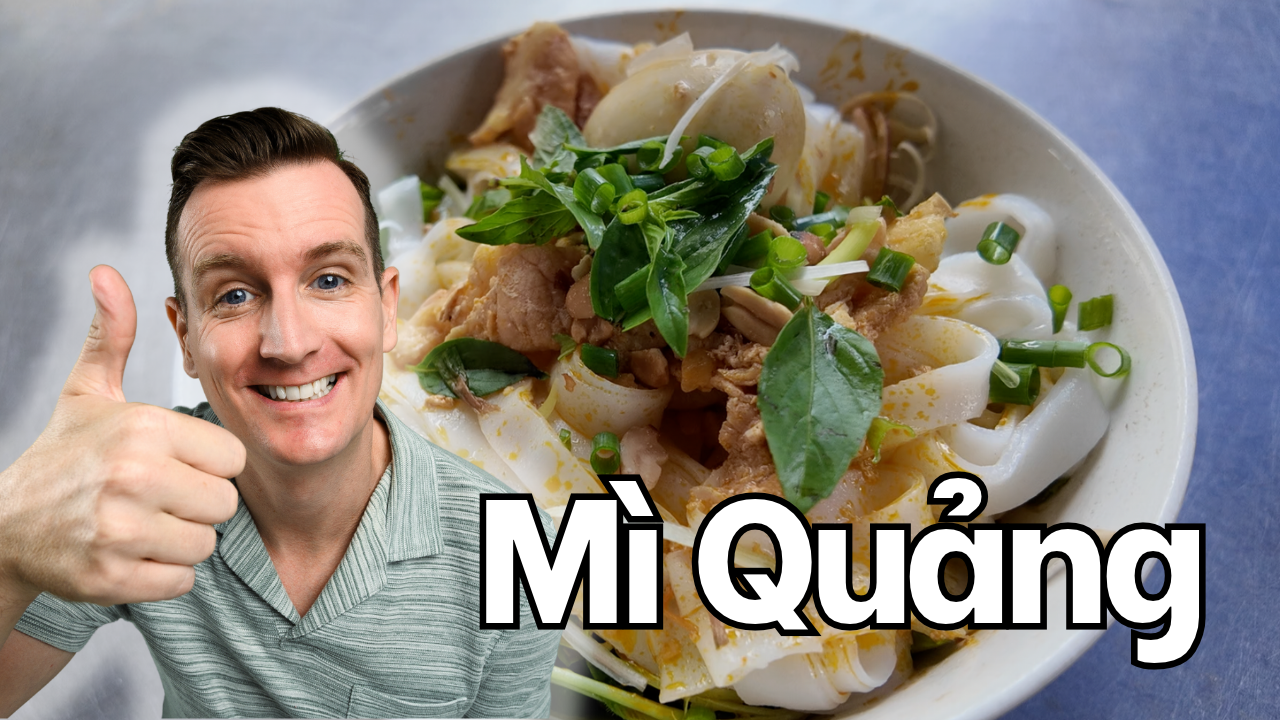
Lunch walk number six is the first one that didn’t start at Saigon Podcast Studio. I’m in Đà Nẵng for a couple of days while Adrie speaks at a conference, and the plan was simple: find a mì quảng place with a 4.9-star rating on Google, film a quick walk, eat something amazing, done.
Because mì quảng is a dish people in central Vietnam are genuinely proud of, and it deserves more attention than it tends to get outside the country.
What Mì Quảng Actually Is
Mì quảng is named after Quảng Nam, the province just south of Đà Nẵng and one of the historic heartlands of central Vietnamese cuisine. It’s often introduced to outsiders as “Vietnam’s other noodle soup,” lined up next to phở and bún bò, but that comparison undersells how different it actually is. Mì quảng isn’t really a soup at all. It’s closer to a noodle salad or a dry noodle dish that happens to be dressed with a small amount of intensely flavored broth, rather than a bowl you’re meant to submerge yourself in.
That single fact — how little liquid is actually in the bowl — is the thing that trips people up most, and it’s worth explaining properly.
The Defining Feature: Almost No Broth
A bowl of proper Quảng Nam-style mì quảng gets just a few tablespoons of broth ladled over the noodles and toppings — enough to moisten everything and coat each strand, not enough to cover them. It’s concentrated almost like a sauce rather than a stock you’d sip on its own. This is by design: the dish is built around texture and layered toppings, and a full bowl of broth would drown all of that out.
This is exactly the contrast I mentioned wanting to check when I set out that day — I’d had mì quảng in Saigon before, and remembered it coming with considerably more broth, and a version that was noticeably thicker and oilier than what I’d had in central Vietnam previously. That’s a real, well-documented regional shift. As the dish traveled south with migration over the decades, southern kitchens adapted it toward what southern diners expect from a noodle dish — more liquid, more richness, sometimes coconut milk worked into the broth for sweetness and body. Purists in Quảng Nam and Đà Nẵng tend to see that southern version as a different animal entirely, closer to a hybrid than a “real” mì quảng. Neither is wrong, exactly — but if you order mì quảng in its home province expecting a Saigon-style bowl, you’ll be surprised by how dry it looks.
The Noodles
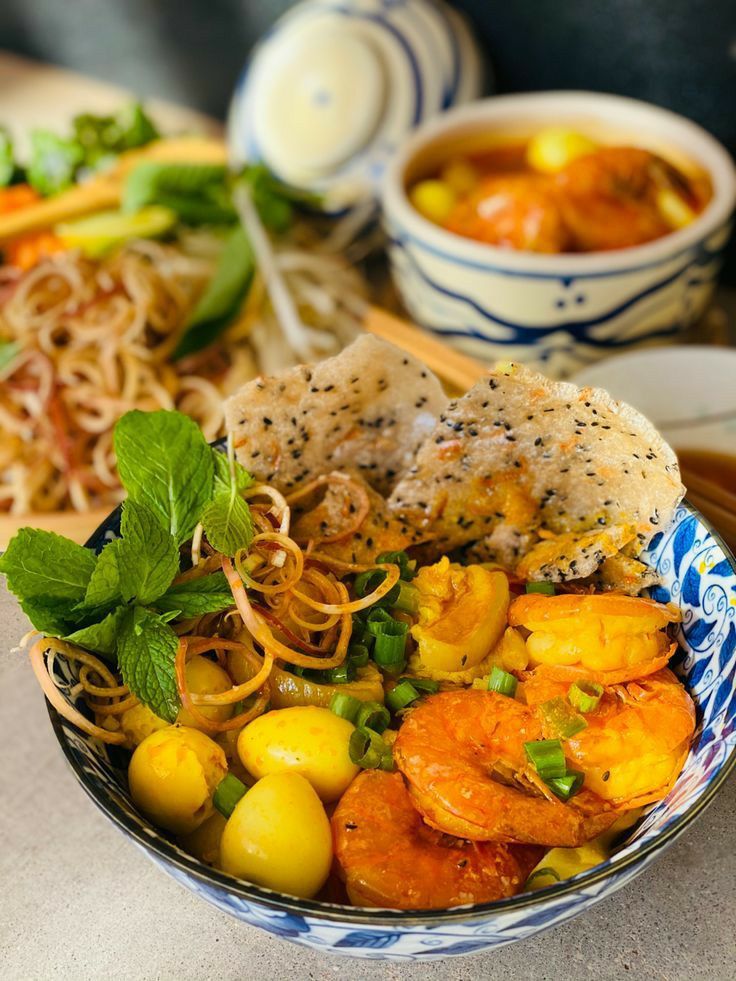
The noodles themselves are flat and wide, cut thicker than phở’s bánh phở, and traditionally rolled and hand-cut from rice flour batter rather than machine-extruded. In their most traditional form, the batter is tinted yellow with turmeric before steaming, which is where a lot of the dish’s signature color comes from — though plenty of shops, including more modern ones, use plain white noodles instead. Some kitchens mix both colors in the same bowl.
Because there’s so little broth to rely on, the noodles themselves have to carry real texture — a bit of chew, enough surface to hold onto the toppings and broth without turning mushy. That’s part of why hand-cut noodles are still valued here: they hold their shape and bite better than thinner, machine-made alternatives.
What’s Actually in the Broth
The broth is built to be strong in a small quantity, not subtle in a large one. It typically starts with pork bones, often combined with dried shrimp or fresh shrimp shells for a savory-sweet seafood note, and sometimes chicken depending on the region or the shop. Turmeric goes in for color and a faint earthiness, and annatto seed oil (dầu điều) is often used too, giving the broth its warm orange-red tint. Shallots, garlic, and fish sauce round out the seasoning.
Compared to bún bò’s broth — built on hours of simmering, lemongrass, fermented shrimp paste, and a long ingredient list designed for a broth you actually drink — mì quảng’s broth is comparatively simple. It doesn’t need the same complexity, because it isn’t the star of the dish. It’s a supporting flavor, meant to tie everything else together rather than dominate it.
The Toppings: Where the Real Variety Lives
If the broth is restrained, the toppings are where mì quảng gets its personality, and this is the part of the dish that varies the most from shop to shop and region to region within central Vietnam. There’s no single “correct” protein — a stall might serve it with shrimp and pork together, sliced chicken, fish, quail eggs halved and tucked in among the noodles, or in some rural areas even frog. It’s not unusual to see two or three proteins combined in one bowl.
Two toppings, though, are close to non-negotiable:
Roasted rice paper (bánh tráng nướng). A piece of crisp, toasted rice cracker is served alongside or crumbled directly over the bowl, adding a shattering crunch against the soft noodles. It’s one of the dish’s most recognizable signatures and something you genuinely miss if a shop leaves it out.
Toasted peanuts. Crushed roasted peanuts are scattered over the top, and they do a lot of quiet work — nuttiness, a bit of fat, and texture. This was, without question, my favorite part of the bowl I finally sat down to eat that day, and it’s often the part that makes the last few bites of a mì quảng bowl better than the first.
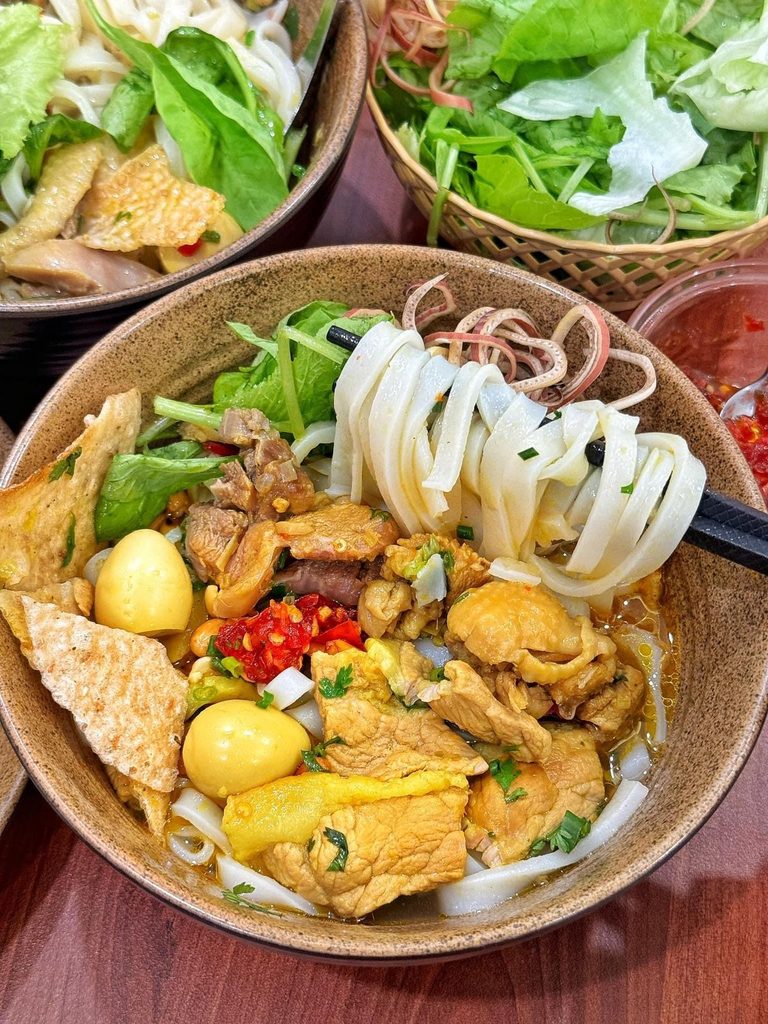
Alongside those, a mì quảng bowl usually comes with a generous side plate of raw greens and herbs — shredded banana blossom, Vietnamese coriander (rau răm), Thai basil, lettuce, and sometimes bean sprouts — reflecting central Vietnam’s general tendency to lean harder on raw, table-added vegetables than the north does.
How It’s Eaten
Because the broth is so minimal, mì quảng isn’t really eaten spoonful by spoonful the way phở or bún bò is. Everything on the plate — noodles, toppings, herbs, crushed rice paper, peanuts — gets tossed and mixed together at the table, so each bite ends up with a bit of everything rather than isolated components. Lime and chili are added to taste, and unlike bún bò, mì quảng isn’t inherently spicy by default; without added chili, it’s a fairly mild, savory dish, which matched what I found that day — the bowl I ate had real depth of flavor without any real heat until I added some myself.
Why It Matters in Central Vietnam
Mì quảng occupies a similar cultural role in Quảng Nam and Đà Nẵng that bún bò holds in Huế — it’s not just a dish, it’s regional identity on a plate. Where bún bò represents Huế’s rich, imperial-influenced, intensely layered approach to flavor, mì quảng reflects a different central Vietnamese philosophy: concentrated, dry, texture-driven, and reliant on quality ingredients rather than a long-simmered broth to do the heavy lifting. It’s considered comfort food by people from the region the way phở might be for someone from Hanoi, and it regularly turns up on international “best Vietnamese dishes” lists — even if, compared to phở and bún bò, it’s still relatively under-the-radar outside Vietnam.