
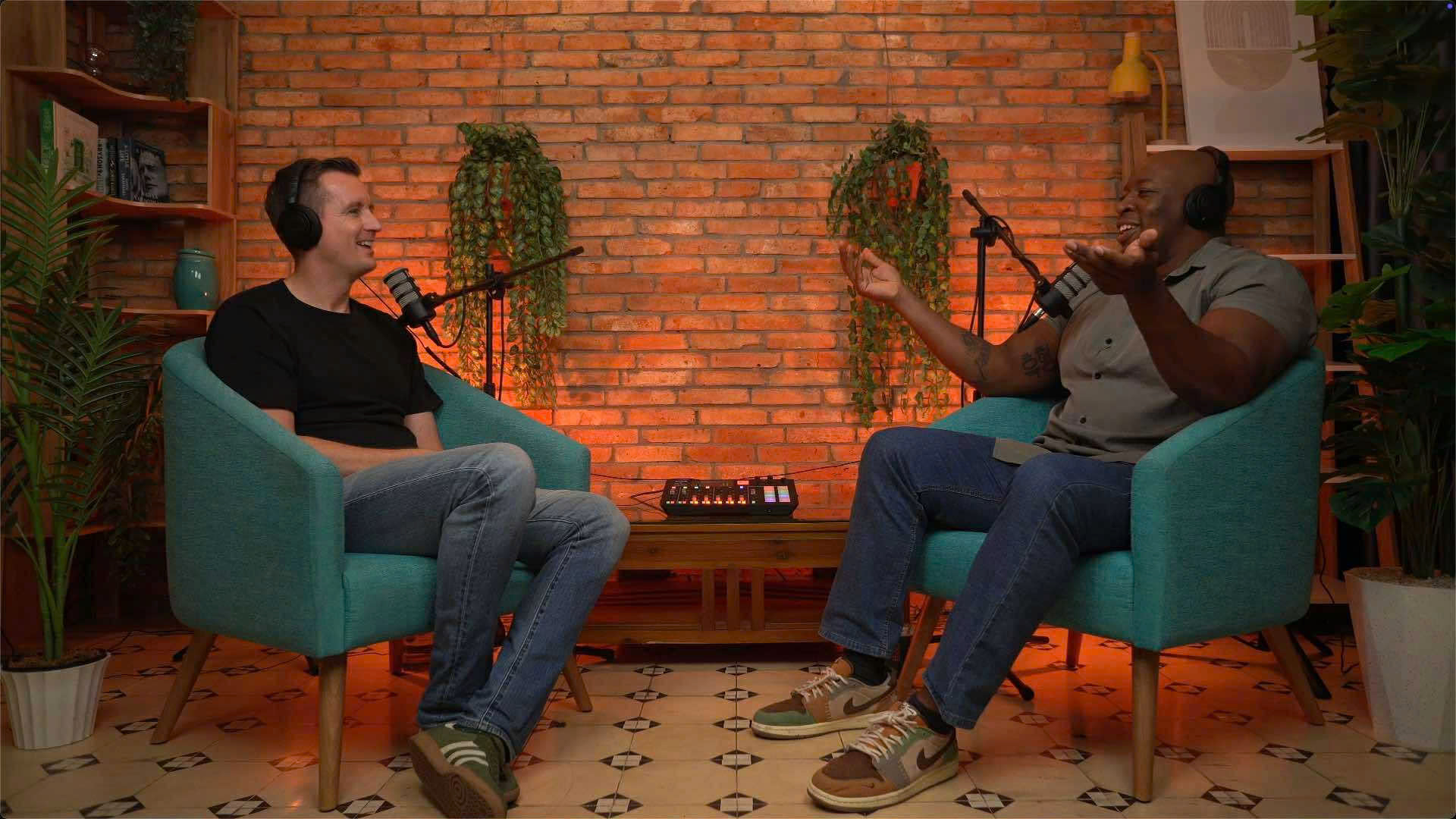


This is Niall Mackay, The Podcast Guy.
I brought back Markeiz Ryan, one of the few guests I’ve had on Discover Vietnam twice. He first joined me back in 2022, when he had just moved here from the United States. Recently, he went viral after CNBC featured him in a video titled Living in Vietnam on $4,000 a Month.
The headline got a lot of attention, but not all for the right reasons. People made quick assumptions. I wanted to hear the full story and share it properly.
Let’s take a deeper look at CNBC’s viral “$4,000 in Vietnam” video. We talked about visas, real living costs, and what it truly means to build a life in Vietnam. Honest insights, not headlines.
From the Air Force to a Fresh Start
Markeiz’s path to Vietnam started in a very different world, the U.S. Air Force. He told me how he was punished for breaking curfew by eight minutes. That small mistake changed everything. He was confined to base for three months, lost rank, and had his pay cut in half.
He said that experience made him realize he needed a change of environment. So when his punishment ended, he packed his bags and came to Vietnam.
It didn’t go smoothly. He got scammed on a visa website, had to buy an emergency visa at the airport, and then his phone was stolen by a taxi driver. For most people, that would have been enough to give up. But he laughed when he told me about it. “After that,” he said, “everything was great.”
That’s something I’ve noticed about many expats who end up happy here. They start with chaos, but somehow, the chaos becomes part of the story.
The Visa Maze
Visas are one of the hardest parts of living in Vietnam. The rules change often, and what’s true this year might not be true next year.
Markeiz explained that he’s now on a student visa, studying a master’s degree through a program between the University of Hawaii and Van Lang University. Before that, he taught English.
He said getting the visa through the university was easier than he expected, though still full of paperwork and waiting. He’s not sure if students are officially allowed to work part-time yet, because it’s still a grey area, but for now, he’s focusing on his studies and improving his Vietnamese.
That reminded me how living here often feels like playing a game without clear rules. You learn by doing, by asking, by making mistakes. There’s no perfect system, and maybe that’s part of the charm.
The $4,000 Misunderstanding
The CNBC headline made it sound like he was spending $4,000 a month to live here. Naturally, people reacted. Some said he was out of touch. Others thought he was bragging.
In reality, that $4,000 figure was his income, not his expenses. It came from his teaching salary, military benefits, and education allowance. CNBC even asked for his pay slips to confirm everything.
He told them he actually spent around $2,000 a month and saved the rest. But when the video was cut down for TikTok, all that context disappeared. The short clip spread quickly, and people filled in the blanks themselves.
He said, “If I really spent $4,000 a month, I’d have a villa and a problem.”
We laughed, but it made me think about how easily stories get twisted online. When people only see a headline, they react based on emotion, not facts.
As a content creator myself, I understand that struggle. You want your story to reach people, but you also want it to be understood. The two don’t always line up.
Read More: Real Cost in Vietnam 2025
What Life in Vietnam Really Costs
When I first came to Vietnam, I thought everything was cheap. You could eat a meal for a dollar, rent a small room for $200, and live comfortably. But that view only goes so far. You can live on $1,000 a month here, but that doesn’t mean you’ll want to.
If you stay in a local area, eat street food, and don’t mind the noise, it’s possible. But if you want some peace, air conditioning that works, and an occasional cappuccino, the price goes up fast.
As Markeiz said, “If you live in Vinhomes Central Park, everything around you costs 50% more.” It’s not just the rent. It’s the coffee, the groceries, even the laundry. Living here is not about being cheap. It’s about finding your balance.
Vietnam is still much more affordable than the U.K. or the U.S., but calling it “cheap” misses the point. What matters is what kind of life you want.
Are Foreigners Raising Prices?
After the CNBC video, a few articles claimed foreigners were driving up housing prices and making life harder for locals. That headline bothered me because it’s not the full picture.
There are about 150,000 foreigners living in Vietnam, out of 100 million people. That’s 0.15% of the population. Even if every foreigner rented a luxury apartment, that number is too small to move the market.
Foreigners also can’t own land here, and by law, only 30% of apartments in any building can be foreign-owned. Most high-end apartments are owned by wealthy Vietnamese and rented out to both locals and foreigners.
So yes, some areas like D2 or parts of Hanoi’s Tay Ho are more expensive. But that’s not because foreigners are inflating prices for the whole country. It’s because those areas were designed for a certain lifestyle.
It’s easy to blame outsiders, but most of Vietnam’s housing boom is driven by local demand and economic growth.
Privilege and Reality
When you live abroad, people make assumptions. Some Americans called Markeiz a “traitor” for living in what they called a “communist country.” Others accused him of showing off.
He wasn’t. He was just sharing what his life looked like.
I’ve faced similar reactions. Some people think living in Vietnam is just an escape or a cheap life hack. It’s not. It’s a real, full life, just in a different place. I came here planning to stay six weeks. Then three months. Then six months. Now it’s been almost ten years.
It’s not always easy. The paperwork, the language barriers, and even simple things like transferring money or getting healthcare can be stressful. But it’s also freeing. You learn to be adaptable. You learn patience. You learn that home is what you build, not where you’re born.
That’s something I wish more people understood, that living abroad is not running away. It’s rebuilding differently.
Why People Keep Coming Back
There’s a pattern I’ve seen over the years. People come to Vietnam, they leave, and then they come back.
This country has a strange pull. It’s not perfect, with its traffic, noise, and chaos, but there’s something about the rhythm of daily life that feels real. You can see progress, but you can still see humanity.
Markeiz and I talked about that sense of belonging. For both of us, Vietnam gave us a second chance. A chance to rebuild our careers, our routines, and maybe even ourselves.
When you leave, you miss the smell of coffee on the street, the sound of rain on metal roofs, the friendliness of people who barely know you. It becomes part of you. That’s why so many of us stay.
What This Conversation Taught Me
After we finished recording, I thought about how often stories online miss the human part. A short clip might go viral, but it rarely shows the truth.
The real story isn’t about money. It’s about choice.
It’s about choosing a life that makes sense for you, not one that fits someone else’s expectations.
It’s about realizing that cost of living isn’t just about dollars. It’s about peace of mind.
And it’s about learning that moving to another country won’t fix your life, but it might help you see it from a new angle.
When I look at Markeiz’s journey, I see more than a headline. I see a reminder that living abroad is not a vacation. It’s a commitment. You trade comfort for growth. You lose familiarity but gain perspective.
That’s the story worth telling.